Pyramidal SH · Oblique ridges
SH(10-11)
SH(10-11) cuts both the basal axes and c axis, turning the rectangular prism rows into oblique ridges with several exposed heights.
- Plane
- (10-11)
- Layer character
- Pyramidal · corrugated
- ASE slab builder
surface
From bulk to facet
How SH(10-11) is cut
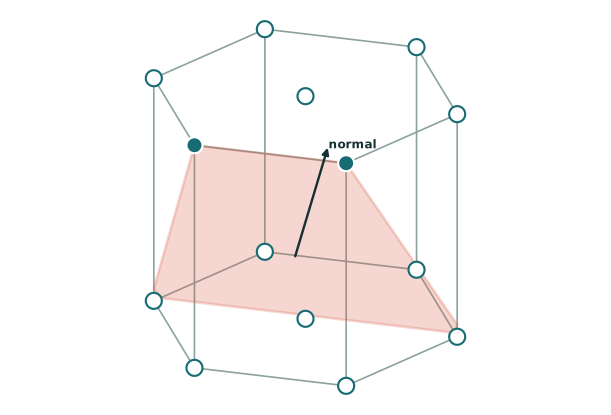
(10-11)
A nonzero l component tilts the (10-10) prism plane towards the basal face, so the sheet crosses both the side and end of the hexagonal prism.
- Bulk lattice
- Simple hexagonal
- Plane normal
- reciprocal vector G(10-11)
- What remains
- Oblique ridges
The plane is drawn through the centre so high-index cuts remain legible. Its orientation is what the indices specify, not its absolute position inside one cell.
Surface geometry
Read the surface from above
L1 is the highest atom-bearing plane, followed by L2 and L3. Support coordinates outside 0–1 are periodic images. The listed Δz describes the supporting atoms, not the marker height. In the interactive model, every numbered site is placed on the same schematic guide plane above the slab; no adsorption distance or energetic ordering is implied.
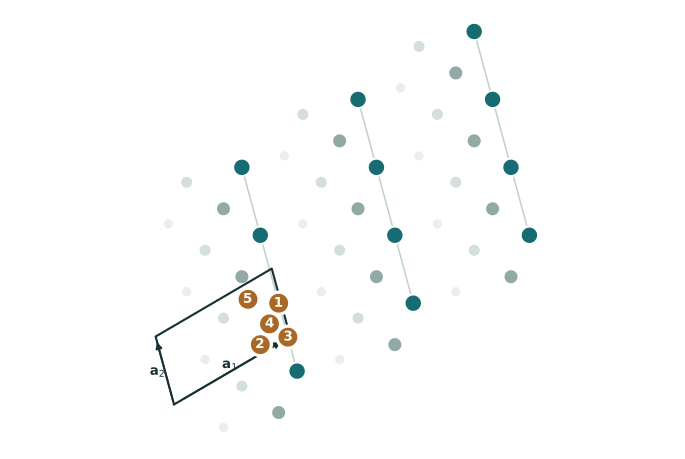
- ridge ontop1-fold
Above an atom on the highest oblique ridge.
(u,v) = (0.982, 0.509)s = s₁ · support shell: mean Δz = +0.000 Å from L1Projection of the L1 atom at (0.982, 0.509).
Not named in ASE - lower-row ontop1-fold
Above an exposed atom in the next lower row.
(u,v) = (0.7618, 0.1191)s = s₁ · support shell: mean Δz = -2.065 Å from L1Projection of the L2 atom at (0.7618, 0.1191).
Not named in ASE - ridge bridge2-fold
Between periodic neighbours along the upper ridge.
(u,v) = (0.982, 0.009)s = (s₁ + s₂) / 2 · support shell: mean Δz = +0.000 Å from L1Periodic midpoint of L1 (0.982, 0.509) and L1 (0.982, -0.491).
Not named in ASE - ridge-to-trough bridge2-fold
Between atoms on adjacent exposed heights.
(u,v) = (0.8719, 0.3141)s = (s₁ + s₂) / 2 · support shell: mean Δz = -1.032 Å from L1Periodic midpoint of L1 (0.982, 0.509) and L2 (0.7618, 0.1191).
Not named in ASE - mixed-height pocket3-fold
A three-atom opening supported by consecutive ridges.
(u,v) = (0.7618, 0.7858)s = (Σᵢ sᵢ) / 3 · support shell: mean Δz = -2.065 Å from L1Least-squares centroid of the 3-atom projected shell: L1 (-0.018, -0.491), L2 (-0.2382, 0.1191), L3 (-0.4585, -0.2708).
Not named in ASE
Interactive model
Rotate the slab
Sites share a schematic display height · drag to rotate · hover for names
Below the top layer
Why the sites are different
Consecutive one-site layers trace a sequence of shifted ridges; mixed-height sites must therefore be read from the profile as well as the top view.
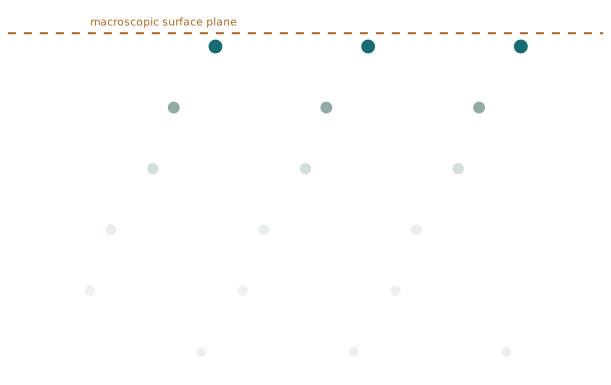
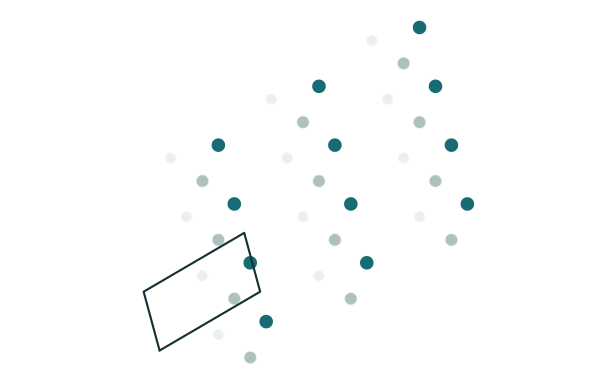
Cell
Geometry at a glance
The spacing follows \(d_{10\bar{1}1}^{-2}=4/(3a^2)+1/c^2\), retaining independent contributions from a and c.
A site name describes the ideal starting geometry. Relaxation can move an adsorbate away from it.
Practical model
Build it with ASE
The builder creates the slab. Sites marked ASE keyword can be passed directly as a named position; ASE source marks current but inconsistently documented support. Other sites require explicit Cartesian coordinates converted from the fractional construction above.
from math import sqrt
from ase import Atoms
from ase.build import surface

a, c = 2.70, 4.40
# X is ASE's dummy atom; replace it with the species being modelled.
sh = Atoms("X", cell=[(a, 0, 0), (-a/2, sqrt(3)*a/2, 0),
                      (0, 0, c)], pbc=True)
slab = surface(sh, (1, 0, 1), 10, vacuum=10)
Things that are easy to misread
- Reusing HCP pyramidal stacking labels for a one-site SH basis.
- Comparing inclinations without holding the c/a ratio fixed.