Stepped FCC · (111) terraces
FCC(211)
FCC(211) is commonly read as narrow (111)-like terraces separated by monatomic (100)-type steps. Terrace and step atoms therefore offer clearly different local coordination.
- Plane
- (211)
- Layer character
- Stepped · kink-free
- ASE slab builder
fcc211
From bulk to facet
How FCC(211) is cut
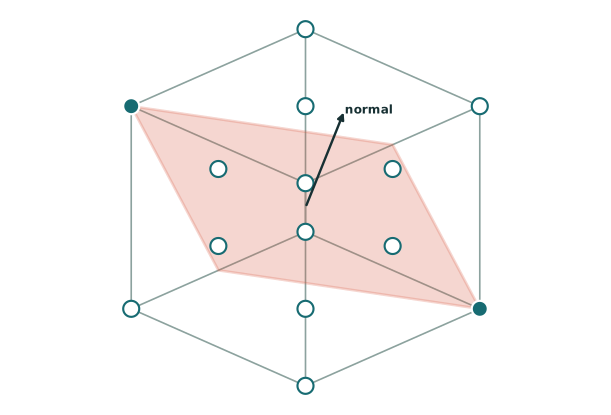
(211)
The [211] normal tilts the cut away from (111). At atomic scale the plane becomes three-row (111)-like terraces separated by single-height steps.
- Bulk lattice
- Face-centred cubic
- Plane normal
- [211]
- What remains
- (111) terraces
The plane is drawn through the centre so high-index cuts remain legible. Its orientation is what the indices specify, not its absolute position inside one cell.
Surface geometry
Read the surface from above
L1 is the highest atom-bearing plane, followed by L2 and L3. Support coordinates outside 0–1 are periodic images. The listed Δz describes the supporting atoms, not the marker height. In the interactive model, every numbered site is placed on the same schematic guide plane above the slab; no adsorption distance or energetic ordering is implied.
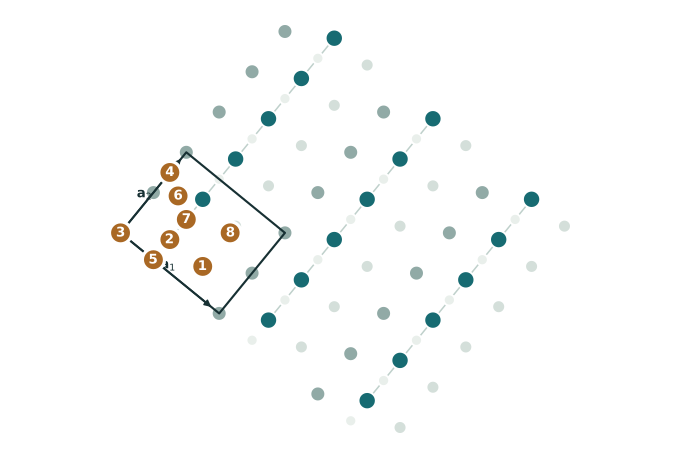
- terrace ontop1-fold
Above an atom within the narrow (111)-like terrace.
(u,v) = (2/3, 1/4)s = s₁ · support shell: mean Δz = -1.474 Å from L1Projection of the L3 atom at (2/3, 1/4).
Not named in ASE - step-edge ontop1-fold
Above a low-coordinate atom at the upper step edge.
(u,v) = (1/3, 1/4)s = s₁ · support shell: mean Δz = +0.000 Å from L1Projection of the L1 atom at (1/3, 1/4).
Not named in ASE - lower-step ontop1-fold
Above the exposed atom immediately below the step.
(u,v) = (0, 0)s = s₁ · support shell: mean Δz = -0.737 Å from L1Projection of the L2 atom at (0, 0).
Not named in ASE - terrace bridge2-fold
Between nearest neighbours within the terrace.
(u,v) = (0, 3/4)s = (s₁ + s₂) / 2 · support shell: mean Δz = -0.737 Å from L1Periodic midpoint of L2 (0, 0) and L2 (0, -1/2).
Not named in ASE - step-edge bridge2-fold
Between adjacent atoms along the upper ledge.
(u,v) = (1/3, 0)s = (s₁ + s₂) / 2 · support shell: mean Δz = +0.000 Å from L1Periodic midpoint of L1 (1/3, 1/4) and L1 (1/3, -1/4).
Not named in ASE - cross-step bridge2-fold
Between atoms on opposite sides of the step.
(u,v) = (1/6, 5/8)s = (s₁ + s₂) / 2 · support shell: mean Δz = -0.368 Å from L1Periodic midpoint of L1 (4/3, 3/4) and L2 (1, 1/2).
Not named in ASE - terrace threefold hollow3-fold
Within a three-atom opening on the terrace.
(u,v) = (1/3, 1/2)s = (Σᵢ sᵢ) / 3 · support shell: mean Δz = -0.737 Å from L1Least-squares centroid of the 3-atom projected shell: L2 (0, 0), L2 (0, 1), L2 (1, 1/2).
Not named in ASE - step threefold hollow3-fold
A mixed-height threefold pocket beside the step.
(u,v) = (2/3, 2/3)s = (Σᵢ sᵢ) / 3 · support shell: mean Δz = -0.737 Å from L1Least-squares centroid of the 3-atom projected shell: L1 (-2/3, 3/4), L2 (0, 1), L3 (-1/3, 1/4).
Not named in ASE
Interactive model
Rotate the slab
Sites share a schematic display height · drag to rotate · hover for names
Below the top layer
Why the sites are different
Rows at the upper ledge have fewer substrate neighbours than atoms inside a terrace. This under-coordination often makes the step edge more reactive than the terrace.
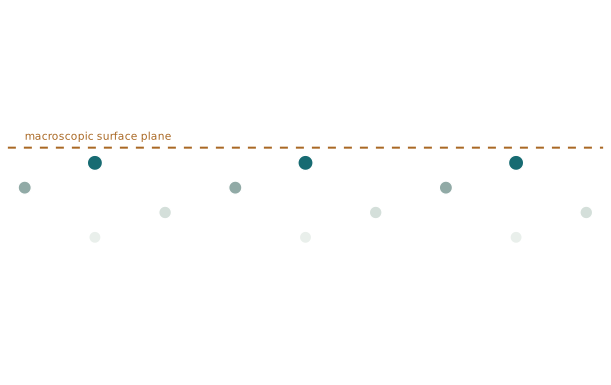
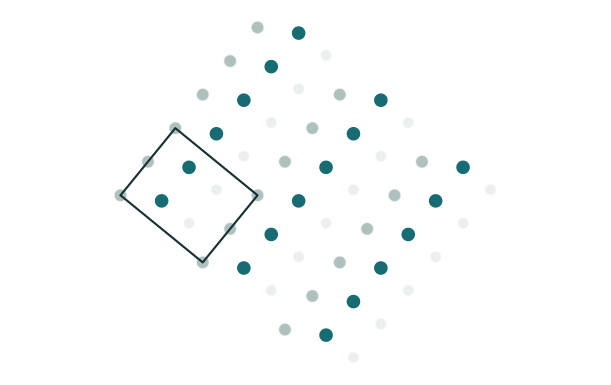
Cell
Geometry at a glance
The reciprocal normal is \([211]\) and \(d_{211}=a/\sqrt{6}\). The periodic surface cell contains the distinct projected rows used in the site constructions.
A site name describes the ideal starting geometry. Relaxation can move an adsorbate away from it.
Practical model
Build it with ASE
The builder creates the slab. Sites marked ASE keyword can be passed directly as a named position; ASE source marks current but inconsistently documented support. Other sites require explicit Cartesian coordinates converted from the fractional construction above.
from ase.build import fcc211

# fcc211() builds the slab, but exposes no named adsorption sites.
slab = fcc211("Cu", size=(3, 2, 8), a=3.61, vacuum=10)
Things that are easy to misread
- Describing the entire facet as a flat (111) plane and omitting the steps.
- Comparing terrace and ledge sites using only their lateral coordination.